Plug-In Solar Pro Duo 890W
Sold by UKSOL Ltd
View at UKSOL Ltd ↗ You buy from the vendor, not from us.
What we checked
Three of the four tests in SI 2026/848 can be spoken to from a published specification. Here is what this kit’s specification says about each — and where it says nothing, so do we.
- AC output is 800W or less — PassesPublished AC output is 800 W, within the 800W ceiling the regulations put on plug-in microgenerators. Figure as published by the vendor; we have not independently measured it.
- Contains no battery — PassesNo storage listed as part of this kit, as required by the plug-in route.
- Appears on the ENA register — Not yet verifiedWe have not matched this kit to a specific entry on the Energy Networks Association Connect Direct register. Vendor names and model names on the register frequently differ from retail names, so an unmatched kit may well be registered under a name we have not linked yet. We would rather say we do not know than guess.
Price history
| Seen | Price | In stock |
|---|---|---|
| 29 Aug 2026 | £1,199.00 | not stated |
The kit
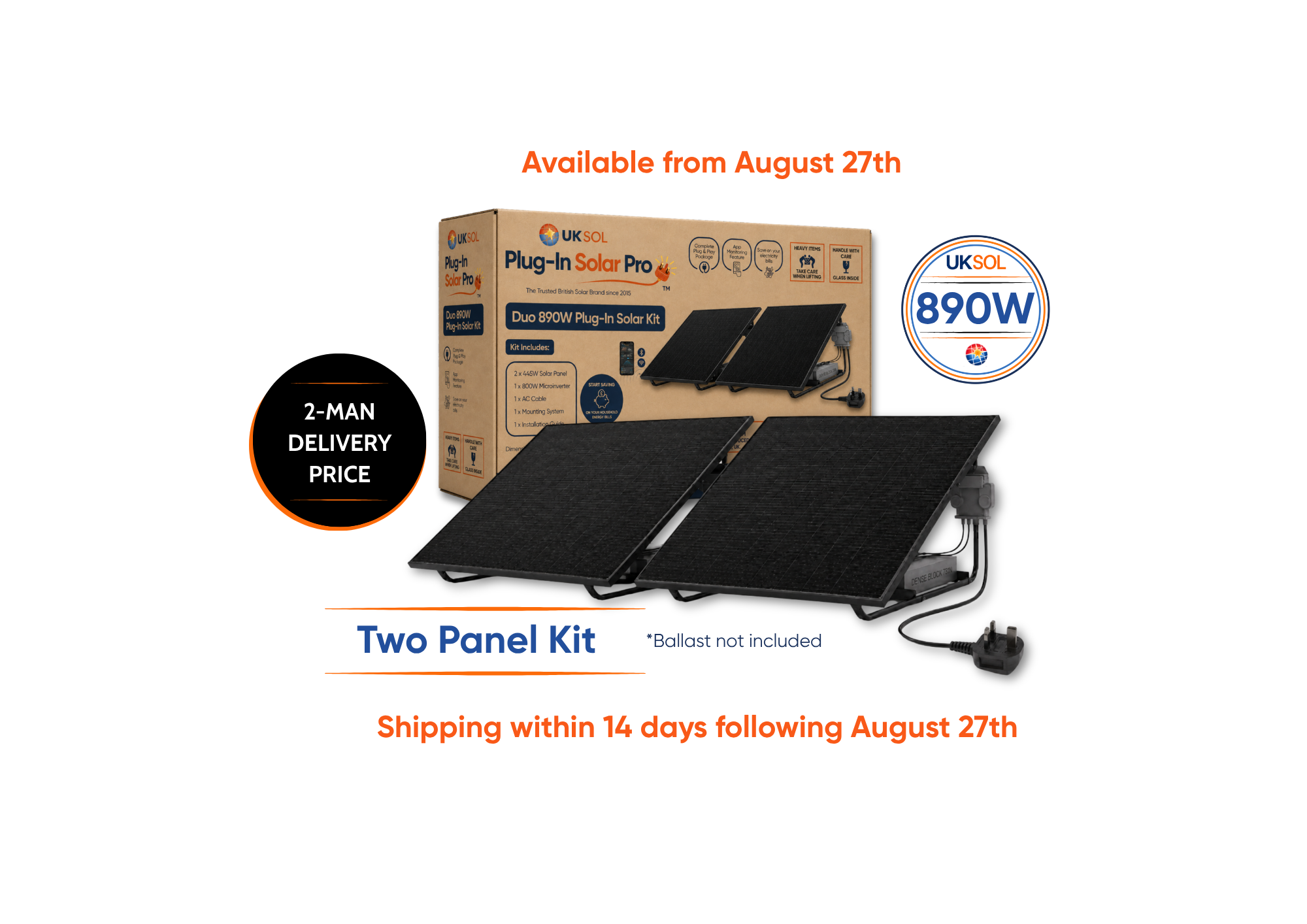
Image: UKSOL Ltd. Reproduced to identify the product being compared; all rights remain theirs. If you are the vendor and would rather we used a different shot, or none, tell us and we will change it.
Specification
| AC output (the 800W cap applies here) | 800 W |
|---|---|
| Panels in the kit | 2 |
| Battery included | No |
| Price | £1,199.00 |
| Price per AC watt | £1.50/W |
10 fields the vendor has not published
- Panel peak output, DC
- Mounting
- Inverter make
- Inverter model
- Battery capacity
- In stock
- Warranty
- Plug type
- Fuse rating
- Vendor offers finance
Blank because the vendor has not stated it, not because we have not looked. We do not fill a gap with an estimate — if you need one of these, ask them, and tell us what they say.
What would this kit save you?
Pre-filled with this kit’s figures — 0.8 kWp of panels as a stand-in, since the vendor has not stated a DC figure (a panel figure, not the 800W AC cap), capped at the 800W AC inverter rating, and the price. Change the tariff and self-consumption to match your own house.
What you will get
Your postcode is turned into coordinates, those coordinates are run through PVGIS — the European Commission’s solar yield model — and the resulting annual generation is valued at your own unit rate. Then it is drawn: what you generate across a day against what your house uses, month by month through the year, and what would change if you pointed it somewhere else.
- Orientation and mounting angle are yours to set above, and they matter: a vertical north-facing balcony rail and a 35° south-facing garden frame are barely the same product. System losses 14% — the PVGIS default.
- Generation is capped at the inverter’s AC rating. Panels bigger than the inverter clip on bright days, and we deduct that — most plug-in kits are deliberately oversized, so it is not a rounding error.
- Only the electricity you use at the moment it is generated counts as a saving. Export is not valued.
- No inflation, no export payment, no panel degradation.